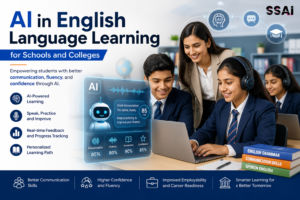
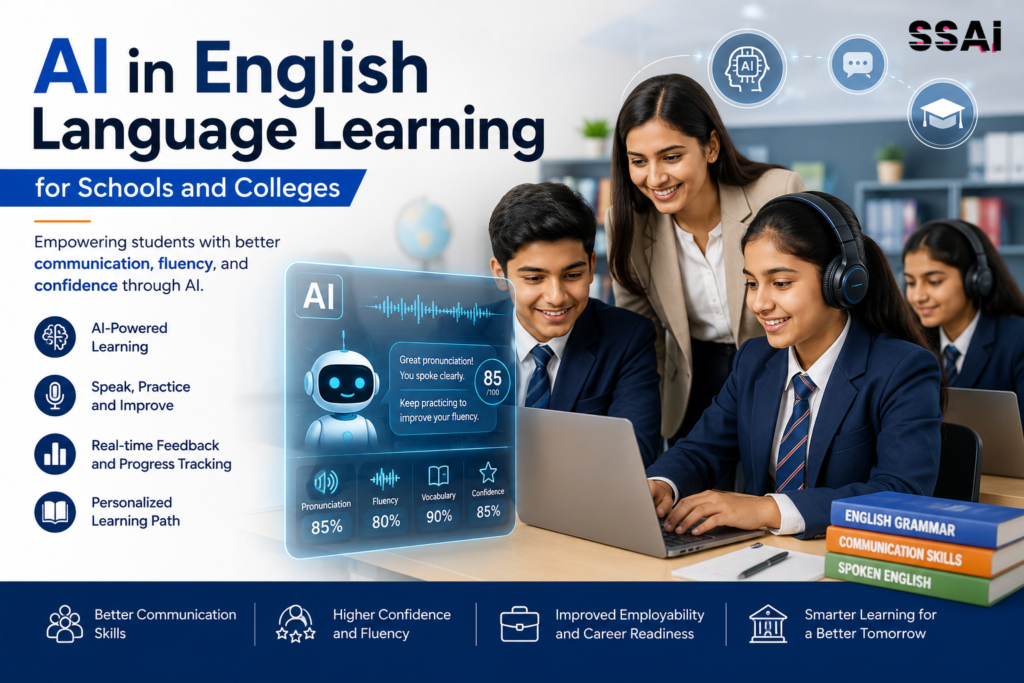
AI in English Language Learning is changing how schools and colleges teach communication, fluency, and speaking skills. For years, students have learned English through textbooks, lectures, grammar exercises, and basic language labs. However, these methods do not always give every learner enough time to speak, practice, and receive personal feedback. Today, AI is helping institutions close this gap by giving students more chances to practice English and understand where they need to improve.
Moreover, AI can support teachers by tracking learner progress, identifying common skill gaps, and providing useful learning data. As a result, schools and colleges can move from a one-size-fits-all approach toward a more personal and practical learning experience.
If you are looking to improve English communication skills at your institution,Request A Demo to see how our AI-powered learning platform can support your students.
What This Article Covers
This article looks at how modern AI is changing English learning and why schools and colleges are adopting new learning tools. You will learn about:
- AI-powered English learning
- Spoken English Training for Students
- Modern English Language Labs
- Pronunciation Improvement
- Communication Skills Development
- Employability Skills
- Interview Readiness
- English Fluency Training
- AI in Education
- Language Learning Technology
- The role of AI platforms in institutional learning
How AI in English Language Learning Improves Student Outcomes
AI in English Language Learning gives students something that traditional classroom teaching can struggle to provide: more opportunities for individual practice.
In a classroom with 30, 40, or even 60 students, it can be difficult for every learner to speak for a meaningful amount of time. A teacher may know that a student has a pronunciation or fluency issue, but there may not be enough time to work with that student individually.
AI can help solve this problem.
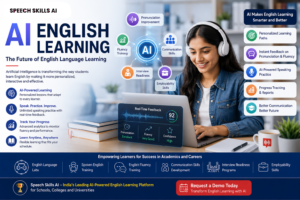
Students can practice speaking, receive feedback, repeat an activity, and track their progress. Furthermore, the system can help identify areas that need more attention.
For example, one student may need help with pronunciation, while another may need to work on fluency and sentence formation. Instead of giving both students the same practice, AI-based platforms can support a more personalized learning path.
According to UNESCO’s work on Artificial Intelligence in Education, AI has the potential to support more inclusive and personalized learning when it is used responsibly.
Therefore, AI is not simply replacing traditional teaching. Instead, it can act as a support layer that helps teachers and learners achieve better results.
AI in English Language Learning and Spoken English Training for Students
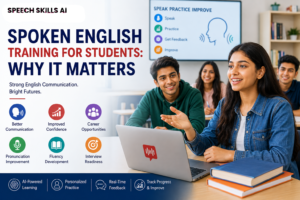
Spoken English Training for Students is becoming increasingly important because academic knowledge alone does not guarantee effective communication.
Many students can understand English but hesitate when they need to speak. They may know the right words but struggle to form sentences quickly. Others may worry about making mistakes in front of classmates.
As a result, students may avoid presentations, group discussions, interviews, and other situations where speaking is important.
Regular practice can change this.
AI-powered speaking tools allow students to practice without the pressure of speaking in front of a large group. They can repeat an activity several times and learn from feedback.
Moreover, this type of practice can help students become more comfortable with:
- Everyday conversations
- Classroom discussions
- Presentations
- Public speaking
- Professional conversations
- Interview questions
The goal is not simply to help students speak more English. The goal is to help them speak with greater clarity, confidence, and purpose.
AI in English Language Learning Through Modern English Language Labs
Traditional English Language Labs have been part of language education for many years. However, modern technology is changing what these labs can offer.
A traditional setup may focus on listening, repeating, and completing fixed exercises. In contrast, an AI-supported language lab can provide a more interactive experience.
Students may be able to:
- Practice speaking
- Receive automated feedback
- Review their performance
- Repeat difficult exercises
- Track progress
- Work on specific language skills
For institutions, this can also make learner management easier. Educators can use performance data to understand where students are struggling and where additional support may be needed.
Furthermore, a modern language lab can help institutions move from simply delivering English lessons to measuring language development.
Pronunciation Improvement Through AI-Powered English Learning
Pronunciation Improvement is one of the most important areas of spoken English development.
A student may have a strong vocabulary and good grammar but still find it difficult to communicate if their pronunciation is unclear. This can affect confidence, classroom participation, presentations, and professional conversations.
AI-powered speech tools can help learners identify pronunciation issues through speech analysis and feedback.
For example, a learner can say a word or sentence, receive feedback, and try again. Over time, repeated practice can help improve clarity.
Furthermore, students can work on specific sounds instead of spending time repeating areas they already understand.
According to Cambridge English, pronunciation is an important part of effective spoken communication and language learning.
Communication Skills Development for Career Success
Communication Skills Development has become a major priority for schools, colleges, and universities.
Employers want graduates who can do more than perform technical tasks. They also need people who can explain ideas, work with teams, communicate with customers, participate in meetings, and present information clearly.
For this reason, communication training should not be treated as an extra activity that students complete only before placements.
Instead, it should become part of the learner’s development throughout their academic journey.
AI can support this process by providing students with more opportunities to practice speaking and receive feedback.
In addition, institutions can use learner data to identify students who may need extra support.
This creates a more proactive approach to communication training.
Building Employability Skills Through Better Communication
Employability Skills include the abilities students need to move successfully from education into the workplace.
Communication is a major part of this.
A graduate may have strong academic results, but poor communication can still affect their ability to perform well in interviews, presentations, meetings, and client discussions.
Consequently, colleges are paying greater attention to communication and other workplace skills.
Students can benefit from practice in areas such as:
- Verbal communication
- Presentation skills
- Active listening
- Confidence
- Team communication
- Professional English
- Problem explanation
- Workplace conversations
The World Economic Forum’s Future of Jobs research also highlights the growing importance of human skills alongside technical skills.
Therefore, English learning should be connected to real career needs rather than limited to exams.
Preparing Students for Interview Readiness
Interview Readiness is another area where better English communication can make a major difference.
Students often know the answer to an interview question but struggle to express it clearly. In other cases, they may become nervous, speak too quickly, use unclear language, or give very short answers.
Regular practice can help.
AI-based learning platforms can provide simulated speaking activities that allow students to practice before entering a real interview.
They can work on:
- Self-introductions
- Common interview questions
- Professional vocabulary
- Answer structure
- Speaking confidence
- Fluency
- Clear pronunciation
As a result, students can enter interviews with greater preparation and confidence.
English Fluency Training in the Digital Age
English Fluency Training should focus on more than grammar rules.
True fluency involves the ability to understand, respond, speak clearly, and communicate ideas naturally.
However, many learners do not get enough speaking practice during their academic years. This is where technology can help.
AI-supported learning can provide regular practice through:
- Guided conversations
- Speaking activities
- Real-time feedback
- Vocabulary exercises
- Pronunciation practice
- Progress tracking
Moreover, students can practice at their own pace.
Someone who needs more time can repeat an activity. Another learner who progresses faster can move to a more advanced activity.
This flexibility makes learning more practical and learner-focused.
The Role of AI in Education
AI in Education is expanding beyond simple automated tasks.
Today, AI can support assessment, personalized learning, feedback, content delivery, learner analytics, and skill development.
However, institutions should not adopt AI simply because it is a new technology.
The better question is:
Does the technology solve a real learning problem?
For English learning, the answer can be yes when AI helps students get more practice, better feedback, and clearer progress data.
Furthermore, AI should support teachers rather than remove the human side of education.
Teachers remain important for motivation, guidance, context, and deeper learning. AI can simply provide additional support between teacher-led sessions.
How Language Learning Technology Is Creating Smarter Classrooms
Language Learning Technology is moving toward more interactive and data-based learning.
Speech recognition, AI feedback, learner analytics, and digital practice tools are making it possible to understand how students learn and where they need help.
For educational institutions, this creates several opportunities.
Instead of asking only:
“Did the student complete the lesson?”
Institutions can start asking:
“Did the student’s speaking ability improve?”
That shift is important.
Learning technology should not only track activity. It should help institutions understand learning outcomes.
This is where platforms such as Speech Skills AI can create value by bringing speaking practice, feedback, pronunciation, fluency, and learner progress into one learning experience.
Why Speech Skills AI Can Support Modern English Learning
Choosing an English learning platform is not only about having AI features. Institutions need a solution that addresses real learner needs.
Speech Skills AI is designed around practical English communication, with a focus on areas such as speaking practice, pronunciation, fluency, and communication development.
For schools and colleges, this approach can support the wider goal of preparing students for academic and professional environments.
The platform can be positioned as a modern solution for institutions looking to strengthen English communication and make language practice more regular, measurable, and engaging.
Most importantly, technology should be used to solve the challenges faced by learners and educators. That is the standard institutions should use when comparing language learning platforms.
The Future of AI in English Language Learning
The future of AI in English Language Learning will likely move toward even more personalized and practical learning.
AI can help institutions understand individual learner needs, provide more speaking opportunities, and give feedback at a scale that is difficult to achieve through classroom teaching alone.
However, technology will only create value when it is connected to a clear learning goal.
The best approach is therefore not AI instead of teachers.
It is AI working with teachers to give students more opportunities to learn, practice, and improve.
Conclusion: Building More Confident English Speakers
AI in English Language Learning is changing how schools and colleges approach English communication. From Spoken English Training for Students and modern English Language Labs to Pronunciation Improvement, Communication Skills Development, Employability Skills, and Interview Readiness, AI can support a much more practical learning experience.
At the same time, English Fluency Training, AI in Education, and Language Learning Technology are helping institutions move toward learning that is more personal, measurable, and focused on real-world outcomes.
For educational leaders, the opportunity is clear: give students more chances to speak, practice, receive feedback, and improve.
If your school, college, university, or training institute is looking to modernize English communication training, Speech Skills AI can help you explore a more practical and technology-driven approach to language learning.
Request a Demo and discover how Speech Skills AI can help your learners build stronger English communication skills and prepare for the demands of higher education and the workplace.