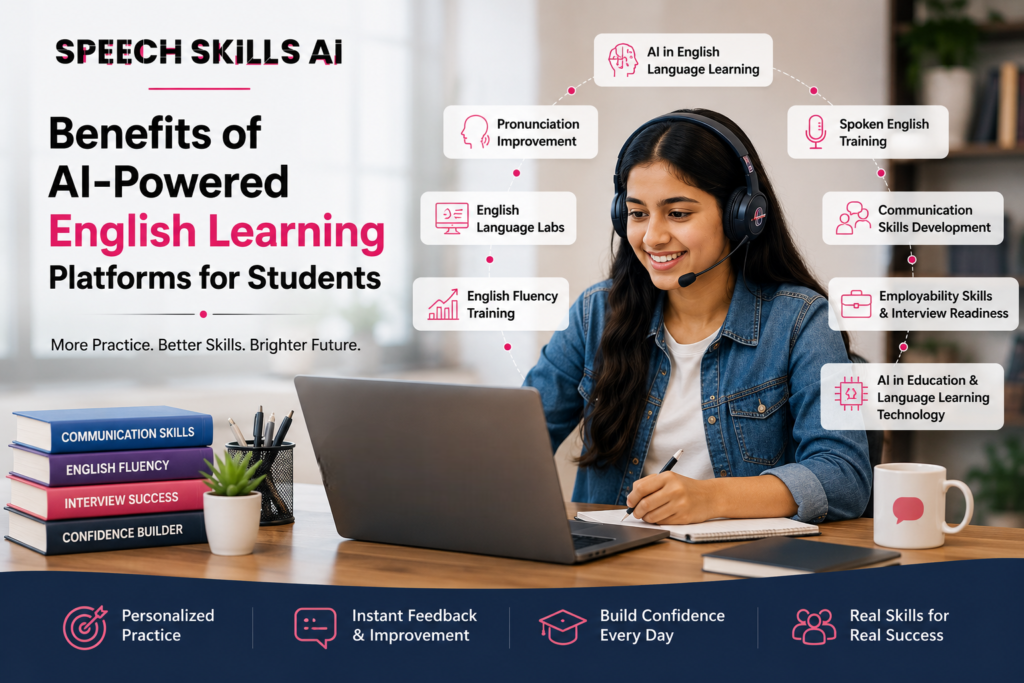
AI English Learning Benefits are becoming increasingly relevant for schools, colleges, and universities that want to improve students’ speaking and communication skills. Today, learners need more than grammar and textbook knowledge. They also need clear pronunciation, confidence, English fluency, and the ability to express ideas in real-life situations.
However, many institutions face a common challenge: how can teachers give every student enough time to practise speaking English? In a large classroom, individual practice can be difficult to manage. This is where AI-powered English learning platforms can help by providing additional practice opportunities and feedback.
When used alongside classroom teaching, these platforms can help students practise regularly, identify areas for improvement, and prepare for academic and professional situations.
Requesting for a Demo to explore how Speech Skills AI can support your institution’s English learning, communication, and employability training goals.
What AI English Learning Benefits Mean for Students
This article explains how AI-powered English learning platforms can support students, teachers, and educational institutions.
- How AI supports English language learning
- Benefits of spoken English practice
- The role of English language labs
- Pronunciation and fluency improvement
- Communication and employability skills
- Interview preparation and student confidence
- Choosing suitable language learning technology
1. AI English Learning Benefits for Language Practice
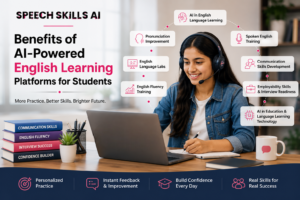
AI in English Language Learning gives students more opportunities to practise beyond regular classroom hours.
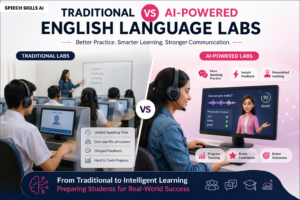
In a traditional classroom, teachers often divide their time among many learners. As a result, some students may not get enough chances to speak, ask questions, or practise difficult sentences.
AI-powered platforms can help fill this gap by providing speaking exercises and interactive practice activities. Students can repeat tasks, work on specific challenges, and improve at their own pace.
For example, a learner who understands English but hesitates during conversations can practise speaking regularly. Similarly, students who struggle to express ideas can work on structured speaking activities.
Most importantly, consistent practice helps students use what they learn instead of relying only on grammar lessons and written exercises.
2. Spoken English Practice Builds Student Confidence
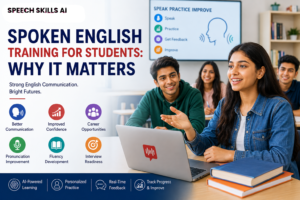
Spoken English Training for Students should focus on more than memorising words or learning grammar rules. Learners also need to use English during presentations, group discussions, interviews, and everyday conversations.
AI-powered platforms can provide opportunities to practise these situations. Students may rehearse introductions, answer questions, explain a topic, or take part in simulated conversations.
Furthermore, learners who feel nervous about speaking in front of classmates can practise individually before participating in group activities.
Teachers still play a vital role in this process. They can guide students, explain mistakes, and help them apply their learning in real conversations. By combining digital practice with human support, institutions can create a more balanced learning experience.
3. AI-Powered English Language Labs
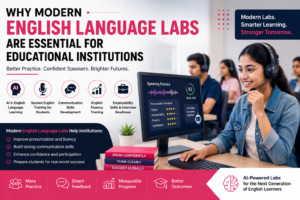
Modern English Language Labs can do more than play recordings or provide grammar exercises. With suitable AI technology, they can offer a wider range of speaking and communication activities.
For example, students can practise:
- Everyday conversations
- Reading aloud
- Presentations and public speaking
- Debates and group discussions
- Interview questions
- Workplace communication
- Explaining ideas clearly
Moreover, teachers can use lab sessions to reinforce classroom lessons. They can introduce a topic, allow students to practise, and then review common challenges.
Consequently, language labs can become an active part of student development rather than a place used only for scheduled exercises.
4. Using AI for Pronunciation Improvement
Pronunciation Improvement is important because students need to communicate clearly and be understood by others.
Some learners know the right words but struggle to pronounce them clearly. Others hesitate because they are unsure how their speech sounds.
Depending on the platform’s features, AI-based tools can provide feedback on spoken responses and give students opportunities to practise words, sentences, and passages repeatedly.
However, pronunciation is only one part of effective communication. Students must also organise their thoughts, choose suitable words, and express their meaning clearly.
The goal is not to make every learner sound the same. Instead, it is to help students communicate in a clear and understandable way.
5. AI English Learning Benefits for Fluency Training
English Fluency Training is not simply about speaking quickly. It involves expressing ideas with ease, connecting thoughts, and responding naturally during conversations.
Many students can write good answers but struggle when asked to explain the same topic aloud. Regular speaking practice can help bridge this gap.
For instance, students can practise storytelling, describe everyday situations, answer open-ended questions, or give short presentations. They can then repeat these activities to build confidence and improve their responses.
Over time, regular practice may help learners become more comfortable using English in different situations.
Therefore, institutions should focus on meaningful speaking activities instead of measuring progress only through written tests.
6. AI and Communication Skills Development
Communication Skills Development includes speaking, listening, presenting ideas, responding to questions, and working with others.
These skills are useful in schools, colleges, internships, and professional settings. For this reason, English learning should connect language knowledge with practical communication.
AI-supported activities can help students practise presentations, group discussions, professional conversations, and public speaking.
Nevertheless, technology alone cannot replace every form of human interaction. Learners also need opportunities to work in teams, receive teacher guidance, and communicate with different people.
The strongest approach combines digital practice with classroom discussions and real-world activities.
7. Building Employability Skills Through English Practice
Employability Skills are increasingly important for students preparing to enter the workforce. Academic knowledge matters, but learners must also explain their ideas, work with others, and communicate professionally.
For example, a student may have strong technical knowledge but find it difficult to explain a project during an interview. Another learner may understand a subject well but struggle to participate in group discussions.
AI-powered English learning platforms can provide additional practice before students face these situations in real life.
Institutions can include professional introductions, workplace conversations, presentations, and problem-solving discussions in their communication programs.
As a result, English learning becomes part of a broader student development plan rather than a subject taught in isolation.
8. AI Practice for Interview Readiness
Interview Readiness requires preparation, repetition, and the ability to respond to questions with clarity.
Traditional mock interviews are useful, but arranging individual sessions for every student can take time. AI-powered platforms may offer additional practice opportunities between formal sessions.
Students can rehearse common interview questions, practise self-introductions, explain their strengths, and learn to organise their answers.
For instance, a final-year student can practise answering, “Tell me about yourself,” before attending a campus placement interview. The learner can then review available feedback and repeat the exercise.
Although AI cannot fully recreate the judgement and interaction of a real interviewer, it can help students prepare before meeting recruiters.
9. AI English Learning Benefits in Education
AI in Education works best when it supports teachers rather than attempting to replace them.
Teachers bring experience, empathy, subject knowledge, and an understanding of each student’s needs. Meanwhile, AI can provide additional practice opportunities and, where available, feedback or progress information.
A practical learning cycle could look like this:
- The teacher introduces a communication skill.
- Students practise using an AI-powered platform.
- Learners review feedback and repeat the activity.
- The teacher discusses common challenges.
- Students apply the skill in a classroom or group setting.
This approach combines technology with human guidance.
Institutions should also consider student privacy, accessibility, feedback quality, and ways to measure learning outcomes before adopting a platform.
For further guidance, explore UNESCO’s work on artificial intelligence in education, which discusses responsible approaches to using AI in learning.
10. Selecting Language Learning Technology for Students
Language Learning Technology should be selected according to learning needs, not simply because it uses artificial intelligence.
Before choosing a platform, schools and colleges should consider these questions:
- Does it offer meaningful speaking practice?
- Can students practise presentations and conversations?
- Does it support pronunciation and fluency development?
- Can teachers review learner progress?
- Is it suitable for the students’ age and skill level?
- Does it fit into existing classes or language lab sessions?
- Are student data and privacy handled appropriately?
- Can the institution assess whether learning outcomes are improving?
These questions help institutions focus on practical value rather than the number of features a platform offers.
For additional English practice resources, students and teachers can also explore the British Council’s LearnEnglish platform.
Why Choose Speech Skills AI for Student Practice?
One of the key AI English Learning Benefits is the opportunity for students to practise communication skills more regularly alongside classroom teaching. Its approach aims to help students practise expressing ideas in different situations rather than focusing only on English words and grammar.
For schools, colleges, and training institutions, the platform can be explored as an additional resource for communication activities, presentations, debates, interview practice, and other learning tasks.
Rather than replacing classroom teaching, Speech Skills AI can complement a broader learning program. Institutions can assess how it fits their students’ needs, teaching methods, and learning goals.
When choosing a solution, educational institutions should look for meaningful practice, useful feedback, and a clear connection between platform activities and learning outcomes.
You can also explore the speechskillsai Features to learn more about its learning and technology solutions.
Conclusion: How AI English Learning Benefits Support Student Success
The AI English Learning Benefits for students include more opportunities to practise, review feedback, and develop communication skills beyond the classroom. When used thoughtfully, these platforms can support Spoken English Training for Students, English Language Labs, Pronunciation Improvement, and English Fluency Training.
They can also contribute to Communication Skills Development, Employability Skills, and Interview Readiness by giving learners more chances to practise real-life situations.
However, the greatest value comes when technology works alongside teachers, structured lessons, and human interaction. Institutions should choose tools that meet clear learning needs, protect student data, and help measure progress.
Speech Skills AI aims to support this modern approach by bringing communication and employability practice into the learning journey.
Give your students more opportunities to practise, communicate, and prepare for their future.
Request a Demo of Speech Skills AI to explore how the platform could support your institution’s English learning and communication goals.