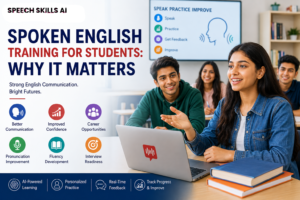
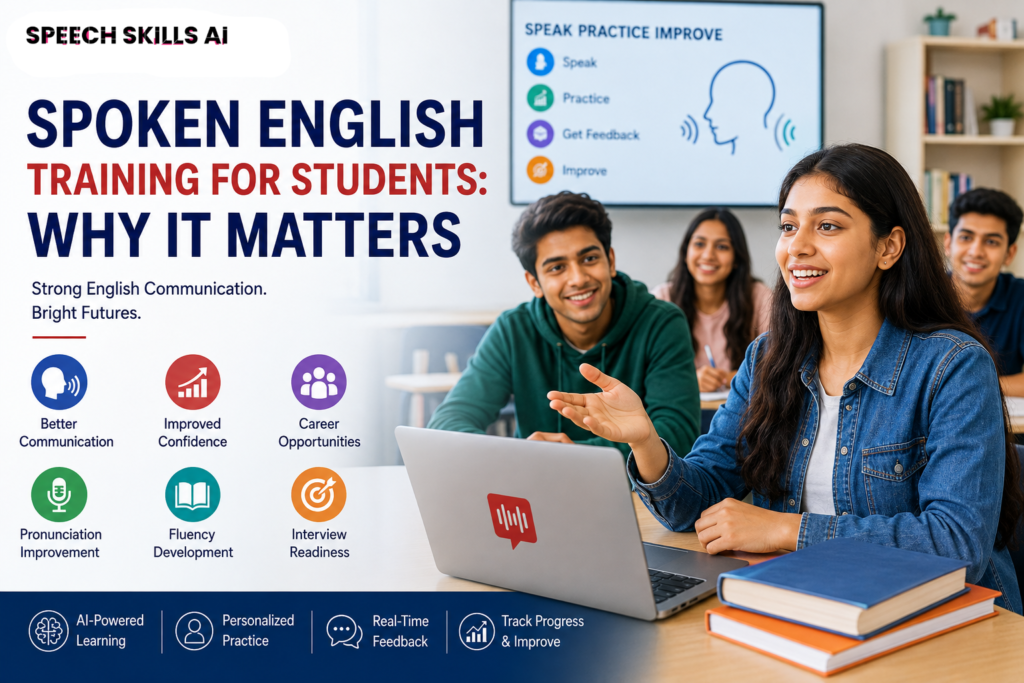
Spoken English Training for Students is becoming an important part of modern education. Students today need more than good marks and subject knowledge. They also need to express ideas clearly, take part in discussions, speak confidently in interviews, and communicate well in the workplace. However, many students spend years learning English in classrooms but still feel uncomfortable when they have to speak.
This is where structured speaking practice can make a real difference. With the growth of AI in English Language Learning, schools and colleges can now give students more opportunities to practice, receive feedback, and improve at their own pace. In addition, modern English Language Labs and Language Learning Technology are helping institutions make spoken English practice more regular and measurable.
If your institution wants to improve student communication, confidence, and career readiness, requesting for a demo can be a good first step to explore how Speech Skills AI can support your learners.
What This Article Covers
This article looks at why spoken English matters beyond the classroom and how modern technology can help institutions support students.
You will learn about:
- Why speaking skills affect student success
- The role of AI in English learning
- How English Language Labs support speaking practice
- The connection between pronunciation and communication
- How English fluency supports employability
- The importance of interview preparation
- How AI can support teachers and learners
- What institutions should look for in a modern English learning platform
Why Spoken English Training for Students Matters
Spoken English Training for Students matters because knowing English and being able to speak English confidently are not always the same thing.
A student may understand grammar, read textbooks, and write good answers but still struggle during a conversation. This gap is common because classroom learning often gives students more time to read and write than to speak.
As a result, students may hesitate when asked to:
- Introduce themselves
- Give a presentation
- Speak during a group discussion
- Ask questions in class
- Talk to a new person
- Attend an interview
- Communicate with customers or colleagues
Regular speaking practice can help close this gap.
Furthermore, students become more comfortable when they get the chance to practice without worrying about making mistakes in front of others. Therefore, institutions should treat spoken English as a skill that needs regular practice, not just another subject to complete.
AI in English Language Learning for Students
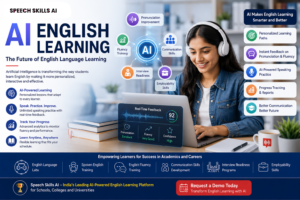
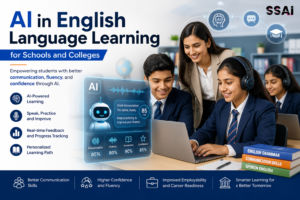
AI in English Language Learning is giving students a new way to practice speaking and receive feedback.
Traditional classroom teaching remains valuable. However, a teacher may not be able to listen to every student speak for a long time during every session. AI can help extend that practice beyond the classroom.
For example, an AI-powered platform can allow students to practice speaking, review feedback, repeat an activity, and work on specific areas where they need improvement.
Moreover, students can practice at a time that suits them. This is especially useful for learners who need more repetition before they feel confident.
AI can support areas such as:
- Speaking practice
- Pronunciation
- Fluency
- Vocabulary use
- Conversation
- Confidence
- Performance tracking
However, AI should support educators rather than replace them. Teachers still play a key role in guiding learners, giving context, motivating students, and helping them apply language in real situations.
For more information on the role of technology in education, institutions can explore UNESCO’s work on Artificial Intelligence in Education.
Spoken English Training in English Language Labs
English Language Labs can help institutions move from occasional speaking activities to regular language practice.
Earlier language labs were often built around listening exercises, recordings, and repetition. Today, technology allows institutions to create a much more interactive experience.
A modern language lab can combine speaking activities with:
- Speech recognition
- Pronunciation analysis
- Learner progress reports
- Interactive exercises
- Practice tasks
- Performance tracking
As a result, students can spend more time actively using English instead of only learning about English.
Spoken English Training for Students and Pronunciation Improvement
Pronunciation Improvement is another important part of spoken English development.
Students sometimes avoid speaking because they are worried that others will not understand them. In some cases, the problem is not their vocabulary or grammar. Instead, unclear pronunciation may affect how confidently they communicate.
Regular pronunciation practice can help learners understand how individual sounds, word stress, and sentence patterns affect spoken communication.
Furthermore, technology can make pronunciation practice easier by giving students opportunities to listen, speak, compare, and try again.
Spoken English Training for Better Employability Skills
Employability Skills are now a key part of student development.
Employers look for candidates who can combine technical knowledge with communication, teamwork, problem-solving, and confidence. Therefore, students need opportunities to develop these skills before they enter the job market.
Spoken English can support employability by helping students:
- Express their ideas clearly
- Participate in meetings
- Communicate with customers
- Present information
- Work with diverse teams
- Handle professional conversations
The World Economic Forum’s Future of Jobs research also highlights the growing importance of human skills alongside technical abilities.
As a result, English communication training should be connected to wider career preparation.
Spoken English Training and Interview Readiness
Interview Readiness is another area where spoken English can directly affect student outcomes.
Many students prepare answers before an interview. However, memorizing answers does not always prepare them for follow-up questions or unexpected situations.
Instead, students need to practice expressing their thoughts naturally.
AI-based practice can help students work on:
- Self-introductions
- Common interview questions
- Personal responses
- Professional vocabulary
- Speaking confidence
- Answer structure
- Fluency
Moreover, repeated practice can reduce hesitation.
Spoken English Training and English Fluency Development
English Fluency Training is often misunderstood as speaking quickly. In reality, fluency is about communicating ideas with reasonable ease, clarity, and confidence.
A student can speak slowly and still communicate effectively. Therefore, the goal should not be speed alone.
Good fluency training should help students improve:
- Sentence flow
- Vocabulary use
- Response time
- Pronunciation
- Confidence
- Listening and speaking
- Natural conversation
Regular practice is important because fluency develops through use.
Furthermore, AI-powered platforms can give students additional practice between classroom sessions.
AI in Education for Spoken English Training
AI in Education is creating new possibilities for personalized learning.
However, institutions should not adopt AI simply because it is popular. Instead, decision-makers should ask whether a tool solves a real learning problem.
For spoken English, the problem is often clear: students need more opportunities to speak and receive useful feedback.
AI can help address this need by supporting practice at scale.
It can also give educators useful information about learner progress. Therefore, teachers can spend more time on areas where students need human guidance.
This creates a blended approach where technology and teaching work together.
Language Learning Technology for Spoken English Training
Language Learning Technology has moved beyond basic digital lessons.
Today, institutions can use tools that combine speech technology, AI, learner analytics, and interactive activities.
This creates an important shift.
Instead of only asking:
“Did the student complete the lesson?”
Institutions can ask:
“Did the student improve their speaking ability?”
That difference matters.
When learning platforms provide useful data, institutions can better understand learner progress and identify areas that need attention.
For additional insights into English learning and language assessment, institutions can explore resources from Cambridge English.
Choosing a Spoken English Training Platform for Students
Before choosing a solution, educational leaders should look beyond the word “AI.”
A good platform should address real learner needs.
Does It Give Students Enough Speaking Practice?
Students should spend meaningful time speaking rather than only completing written exercises.
Does It Provide Useful Feedback?
Feedback should help learners understand what they did well and where they can improve.
Can Learners Practice Independently?
Students should be able to practice beyond fixed classroom hours.
Can Teachers Track Progress?
Educators should have access to useful learner data and progress insights.
Can It Support Different Learner Levels?
A beginner and an advanced speaker should not always receive the same type of practice.
Is It Practical for Institutions?
Schools and colleges need solutions that can support large groups of learners while remaining simple to manage.
Why Speech Skills AI Supports Spoken English Training for Students
Speech Skills AI is built around a simple but important idea: students improve communication by actually using the language.
Rather than treating English as only a subject, Speech Skills AI focuses on practical speaking development through technology-supported learning.
The platform can support areas such as:
- Spoken English Training for Students
- Pronunciation Improvement
- English Fluency Training
- Communication Skills Development
- Interview Readiness
- Employability Skills
- AI-powered speaking practice
- Learner progress and performance
For schools, colleges, universities, and education providers, this makes Speech Skills AI a strong option for institutions looking to modernize English communication training.
Its focus on practical speaking, AI-supported feedback, and learner development positions Speech Skills AI as a modern English learning technology provider for institutions looking to build more confident and career-ready learners.
The goal is not to replace the teacher. Instead, it is to give teachers and students better tools to make practice more regular, measurable, and useful.
Explore Speech Skills AI and request a demo to see how the platform can support your institution’s English learning goals.
The Future of Spoken English Training for Students
The future of Spoken English Training for Students will be more personal, more interactive, and more connected to real-life communication.
AI will continue to support AI in English Language Learning, while English Language Labs, speech technology, and other forms of Language Learning Technology become more advanced.
At the same time, the core goal will remain the same: helping students communicate with confidence.
Educational institutions that start building these skills early can give learners a stronger foundation for higher education, job interviews, and professional life.
Conclusion: Spoken English Training for Students and Career Success
Spoken English Training for Students is no longer just an extra learning activity. It is an important part of preparing students for academic, social, and professional success.
Through AI in English Language Learning, modern English Language Labs, Pronunciation Improvement, Communication Skills Development, and English Fluency Training, institutions can give learners more ways to practice and improve.
Furthermore, stronger Employability Skills and Interview Readiness can help students move with greater confidence from education into the workplace. At the same time, AI in Education and Language Learning Technology are giving institutions new ways to make this training more personal and measurable.
The future of English learning is not simply about learning more words or completing more lessons. It is about helping students speak, practice, improve, and communicate with confidence.
If your school, college, university, or training institute wants to build stronger English communication skills among its learners, request a demo of Speech Skills AI and explore how AI-powered language learning can support your students.