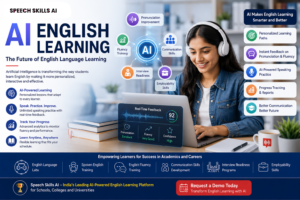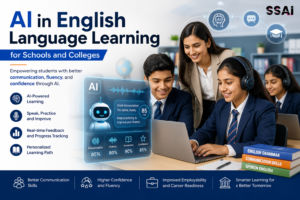
AI Learning Tools are changing how schools, colleges, universities, and training institutions approach English and communication training. Traditional English teaching still plays an important role in grammar, vocabulary, reading, writing, and classroom interaction. However, modern students also need regular speaking practice, Pronunciation Improvement, Communication Skills Development, Employability Skills, and Interview Readiness.
So, which approach delivers better results?
The answer is not simply about choosing AI over teachers or classrooms over technology. Instead, the strongest model combines the strengths of both. Traditional teaching provides human guidance and interaction. Meanwhile, AI gives learners more opportunities to practise, receive feedback, and improve at their own pace.
For institutions exploring this approach, request a demo of Speech Skills AI to see how an AI-powered communication platform can support existing English and employability programs.
What This Article Covers
This article compares traditional English learning with modern AI Learning Tools from the perspective of students, teachers, and institutions.
You will learn about:
- Traditional classroom-based English learning
- AI-powered English practice
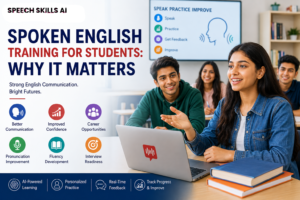
- Spoken English Training for Students
- English Language Labs
- Pronunciation Improvement
- English Fluency Training
- Communication Skills Development
- Employability Skills
- Interview Readiness
- The role of AI in Education
- How Language Learning Technology can support teachers
Most importantly, we will look at how institutions can combine both approaches instead of treating them as competing systems.
Traditional Learning and AI Learning Tools
Traditional English classes continue to offer benefits that technology cannot fully replace.
A teacher can notice when a student is confused, explain a concept differently, encourage participation, and understand the learner’s situation. In addition, classroom activities create social interaction that helps students learn from their peers.
Teachers can conduct:
- Group discussions
- Presentations
- Debates
- Role plays
- Reading activities
- Grammar exercises
- Vocabulary activities
- Interview preparation
As a result, traditional learning remains an important part of language education.
However, there is one common challenge.
A teacher may have 30, 40, or even more students in a class. Therefore, giving every learner several minutes of individual speaking practice during every lesson can be difficult.
Some students participate often, while quieter learners may get fewer opportunities.
That is where AI Learning Tools can add value.
How AI Learning Tools Change English Practice
AI Learning Tools can help address one of the biggest challenges in language education: limited access to individual practice.
Instead of waiting for the next classroom session, learners can practise speaking when they have time. They can repeat activities, try different conversations, and work on areas where they need more support.
For example, one student may need Pronunciation Improvement, while another may need better fluency. A third learner might communicate well in daily conversations but struggle during an interview.
The role of AI in education is also being studied from the perspective of responsible and human-centred learning. UNESCO’s guidance on AI and education highlights the need to use AI in ways that support learners and educators.
With the right Language Learning Technology, each learner can get opportunities to practise different skills.
Importantly, AI does not have to replace the teacher.
Therefore, the better question for institutions is not:
“Can AI replace our English teacher?”
Instead, ask:
“Can AI help our teachers give students more meaningful practice?”
Spoken English Training for Students Needs More Practice
Spoken English Training for Students becomes more useful when learners get frequent chances to speak.
A student may understand grammar and vocabulary but still hesitate when asked to speak. Often, the issue is not a lack of knowledge. Rather, it is a lack of practice and confidence.
AI can create a safe space for repeated speaking activities.
Students can practise:
- Conversations
- Questions and answers
- Presentations
- Debates
- Interviews
- Professional situations
- Everyday communication
Furthermore, learners can repeat the same type of activity until they become more comfortable.
Speech Skills AI takes this broader approach by positioning itself as an AI Communication Coach and an AI-powered Communication & Employability Platform rather than only an English learning product.
That distinction matters.
English provides the foundation. However, communication, confidence, and employability are the larger outcomes.
AI Learning Tools in English Language Labs
English Language Labs have traditionally supported listening, speaking, pronunciation, and language exercises.
Today, however, digital technology can make these labs more interactive.
Instead of only listening to a recording and repeating sentences, learners can practise conversations, presentations, interviews, debates, and other real-world situations.
This changes the purpose of the language lab.
It becomes a place where students can practise using English, rather than simply completing language exercises.
Therefore, institutions do not necessarily have to choose between a classroom and technology.
A modern English Language Lab can support what teachers already do.
Pronunciation Improvement Through AI Learning Tools
Pronunciation Improvement is another area where repeated practice can help.
A learner may know the correct word but hesitate because they are unsure how to say it. Similarly, another student may speak confidently but need help making their speech clearer.
Teachers can identify these issues, of course. Yet limited classroom time can make it difficult to provide individual practice to every learner.
AI can add another layer of support.
A learner can practise speaking, review feedback, make adjustments, and try again. Over time, this repeated process can make practice more consistent.
Still, pronunciation should not be the only measure of communication ability.
The real goal is clear, confident, and useful communication.
English Fluency Training With Digital Practice
English Fluency Training should not simply focus on how quickly a student speaks.
True fluency is about expressing ideas with reasonable ease and clarity. A learner should be able to explain an idea, ask a question, respond to another person, and continue a conversation without relying only on memorized sentences.
Traditional classroom lessons can establish the foundation.
AI can then provide additional practice.
For example:
Teacher explains → student practises → AI provides feedback → student repeats → teacher reviews progress
As a result, students can turn classroom learning into repeated practice.
This is one of the strongest reasons for combining traditional instruction with technology.
Communication Skills Development Goes Beyond English
Communication Skills Development is broader than grammar and vocabulary.
Students need to communicate during presentations, group discussions, interviews, debates, meetings, and professional conversations.
Modern AI platforms can support these activities by giving learners additional opportunities to practise.
Therefore, institutions should ask a bigger question:
Can students use what they have learned in real communication situations?
That question moves English learning beyond textbooks.
It also connects language education with confidence and career readiness.
Employability Skills Start With Communication
Employability Skills have become an important part of student development.
A graduate may have strong technical knowledge but still struggle to explain ideas during an interview. Another student may have good academic results but feel uncomfortable giving a presentation.
Communication can affect how students perform in these situations.
That is why English programs should connect with practical activities such as:
- Presentations
- Interviews
- Group discussions
- Business pitches
- Workplace conversations
- Team communication
As a result, colleges can use communication practice as part of a wider employability program.
Interview Readiness Requires Realistic Practice
Interview Readiness should not begin a few days before campus placements.
Students need time to practise introducing themselves, answering questions, explaining their skills, and responding when an interviewer asks something unexpected.
Traditional mock interviews are valuable. However, the number of mock interviews each student receives may be limited.
AI can provide additional practice between formal sessions.
Students can practise:
- Self-introductions
- Common interview questions
- Role-specific questions
- Follow-up questions
- Professional communication
- Confidence during interviews
Moreover, repeated practice can make the actual interview feel less unfamiliar.
For colleges, this creates a useful connection between communication training and placement preparation.
AI in Education Works Best With Teachers
AI in Education should not be presented as a competition between teachers and technology.
Instead, the two can serve different purposes.
Teachers Provide Human Guidance
Teachers can offer:
- Context
- Mentoring
- Motivation
- Classroom interaction
- Personal guidance
- Deeper feedback
AI Learning Tools Provide Scalable Practice
AI can support:
- Repeated practice
- On-demand activities
- Instant feedback
- Individual practice
- Digital tracking
- Flexible learning
Consequently, a blended model can give teachers more support while giving students more practice time.
AI Learning Tools vs Traditional Learning: A Simple Comparison
The differences become clearer when we compare the two approaches.
| Traditional Learning | AI-Supported Learning |
|---|---|
| Teacher-led instruction | AI-guided practice |
| Classroom interaction | Individual practice |
| Human feedback | Technology-based feedback |
| Group activities | Personalized repetition |
| Fixed class schedule | Flexible practice |
| Teacher observation | Digital progress tracking |
| Social learning | On-demand learning |
However, this comparison does not mean one side is automatically better.
Instead, it shows where each approach can add value.
The strongest learning model can bring both together.
Why Speech Skills AI Fits the Modern Learning Model
Speech Skills AI is built around the idea of giving learners more opportunities to practise communication.
The platform’s broader approach covers speaking, debate, reading, presentations, interviews, business pitches, and improvement activities.
This gives Speech Skills AI a broader position than a traditional English practice tool.
It can support institutions that want to connect English learning, communication, confidence, and employability in one learning journey.
Rather than saying that AI should replace traditional English education, the stronger message is:
Keep the teacher. Increase the practice. Measure the progress.
That is where AI can create practical value.
A Blended Model With AI Learning Tools
Schools and colleges do not need to replace their existing English programs.
Instead, AI can be added at important stages.
Before Class
Students complete a short practice activity.
During Class
Teachers focus on discussion, explanation, teamwork, and human feedback.
After Class
Learners practise again and work on areas that need improvement.
Before Interviews
Students complete realistic interview practice.
Before Presentations
Learners rehearse their presentation and improve their delivery.
After Assessments
Teachers can review learner progress and identify areas that need more support.
In this way, Language Learning Technology becomes an extension of classroom learning rather than a replacement for it.
What Should Institutions Check Before Choosing AI Learning Tools?
Before investing in an AI English or communication platform, education leaders should ask a few practical questions.
Does the platform provide real speaking practice?
Can learners practise more than pronunciation?
Does it support communication and employability?
Can teachers monitor learner progress?
Can students practise independently?
Does it work with the institution’s existing learning program?
Can the institution measure learner outcomes?
These questions are more useful than simply asking whether a product uses AI.
Technology matters.
However, learning outcomes matter more.
AI-Powered English Learning: What Works Best?
When comparing AI-supported English learning with traditional methods, there is no need to declare one approach the winner.
Traditional teaching is strong at explanation, human guidance, classroom interaction, motivation, and social learning.
AI is strong at repeated practice, flexible access, personalized activities, and scalable support.
Therefore, the strongest model is often a combination of both.
A teacher can introduce the concept.
AI can provide additional practice.
The student can repeat the activity.
The teacher can review progress.
Then, the learner can practise again.
This creates a continuous learning cycle instead of limiting communication practice to classroom hours.
The Future of English Learning With AI Tools
The future of AI Learning Tools is not about removing teachers from the learning process.
Instead, it is about giving teachers and students better tools.
Traditional teaching can provide the human foundation. AI can increase the amount of practice available to each learner.
As a result, students can move beyond simply understanding English and begin using it with greater confidence.
That matters because modern learners need more than grammar knowledge.
They need Pronunciation Improvement, English Fluency Training, Communication Skills Development, Employability Skills, and Interview Readiness.
Furthermore, institutions need ways to support these outcomes at scale.
That is where AI in Education and modern Language Learning Technology can play a useful role.
Conclusion: AI Learning Tools and Traditional Teaching Can Work Together
AI Learning Tools and traditional English education should not be treated as opposing systems.
Traditional teaching remains essential for human guidance, classroom interaction, explanation, motivation, and mentorship. At the same time, AI can provide more opportunities for practice, feedback, repetition, and flexible learning.
For this reason, modern Spoken English Training for Students can benefit from combining classroom instruction with AI-based practice. Likewise, English Language Labs can evolve from basic language exercises into spaces for speaking, presentations, interviews, and real communication.
The same approach can support Pronunciation Improvement, English Fluency Training, Communication Skills Development, Employability Skills, and Interview Readiness.
Speech Skills AI follows this broader direction by positioning itself around communication and employability, rather than simply teaching English.
For schools, colleges, universities, and training organizations, the goal should therefore be simple:
Keep the teacher. Increase the practice. Measure the progress.
If you want to explore how Speech Skills AI can complement your existing English, communication, or employability program, request a demo of Speech Skills AI.